Decision Guide
Walk-In Shower vs Tub: Which Is Right for Your Roanoke Home?
The question is not really tub or shower. It is whether the house still has a tub afterwards.
One tub per house
A household with small children needs somewhere to bathe them, and a shower is not that place. So the tub in your house is not competing with the shower you want; it is competing with the buyers who will not consider a house without one. Once there is a tub somewhere, the constraint is gone and every other bathroom in the house is free.
That collapses the decision into three cases:
- Two or more bathrooms, converting a secondary one: convert. The tub stays elsewhere and nothing is lost.
- Two or more bathrooms, converting the primary: a shower-only primary is fine as long as a tub survives somewhere in the house. In the upper Roanoke price bands, buyers expect a soaking tub in the primary itself, which is why a big primary usually ends up with both.
- One bathroom, common in Old Southwest and older Salem: keep the tub, and make it a tub-shower combo with modern tile and fixtures. This is the case where converting closes the door on a large share of the buyer pool.
Neighborhood matters only through that lens. Old Southwest is mostly single-bathroom houses, so the answer there is usually the third case. Cave Spring and Hunting Hills are mostly two-and-three-bathroom houses, so the answer there is usually the first. The rule does not change from street to street; the housing stock does.
Lifestyle factors that override resale
Resale is not the only variable. Some situations lean heavily toward walk-in shower regardless of resale math:
- Aging in place. Stepping over the wall of a tub means standing on one leg on a wet surface, which is the single most dangerous thing that happens in a bathroom. A curbless shower removes that movement from the day entirely.
- Mobility limitations. The same point applies to any knee, hip or balance issue, permanent or temporary.
- Nobody in the household bathes in tubs. If the tub is storage for shampoo bottles and you are staying in the house, it is a fixture you are maintaining for a buyer you have not met.
- Serious shower preferences. If you want multiple shower heads, a rain head, a bench, or other spa features, a walk-in shower gives you room to build them. A tub-shower combo constrains all of it.
Design considerations for walk-in showers
If you are converting, several design decisions shape the outcome:
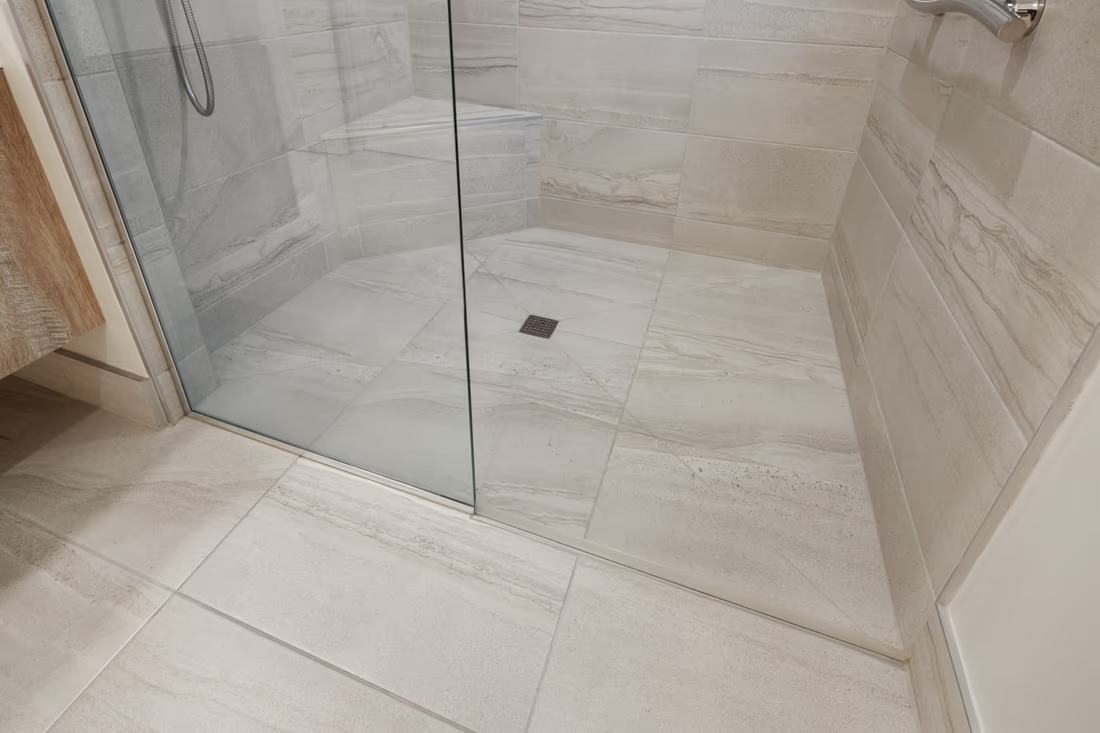
- Curbed vs curbless. Curbless is safer and more contemporary, and it costs more ($1,500-$2,500) because the subfloor has to be recessed for the shower floor to sit flush with the room and still fall to the drain. A curb is cheaper, simpler, and something to step over every day.
- Enclosure type. Frameless glass ($1,500-$3,000) looks better than semi-frameless ($800-$1,500) but is more expensive. Fixed glass panels ($500-$1,000) are the cheapest option but require the shower to be sized so you do not need a door.
- Drain type. Point drain (center, cheaper) forces small tile on the floor. Linear drain (along one wall, $400-$800 more) allows large-format tile.
- Bench and niche. Add during the design phase, not after, they need to be framed and waterproofed as part of the shower structure.
- Fixture package. Standard single-head is $400-$800 in fixtures. Adding a rain head is $300-$600 more. Multiple body sprays or a hand shower add $500-$1,200.
Design considerations for tubs
If you are keeping a tub, choose the right type:
- Alcove tub (built into three walls): Cheapest, most common. $400-$1,500 in the tub itself.
- Drop-in tub (installed into a tiled deck): Design-forward, moderate price. $800-$2,500 in the tub. The tiled surround adds $2,000-$5,000 to the project.
- Freestanding tub (standalone, spa-scale): Design statement. $1,200-$4,500 in the tub. Requires joist verification in older homes.
- Tub-shower combo (alcove tub with shower valve above): The right call for hall baths in 1-bathroom homes. Same $400-$1,500 in the tub plus a full tile surround.
The compromise: primary with both
Larger primary suites can fit both a walk-in shower and a freestanding tub, which is what the upper end of the Roanoke market has settled on. It adds $8,000 to $15,000 over a shower-only or tub-only primary, and it is the version of this decision that never has to be revisited.
Get a free quote
Call (540) 384-4486 or use the quote form for a free quote. Or read more on walk-in shower conversions or tub-to-shower conversions.